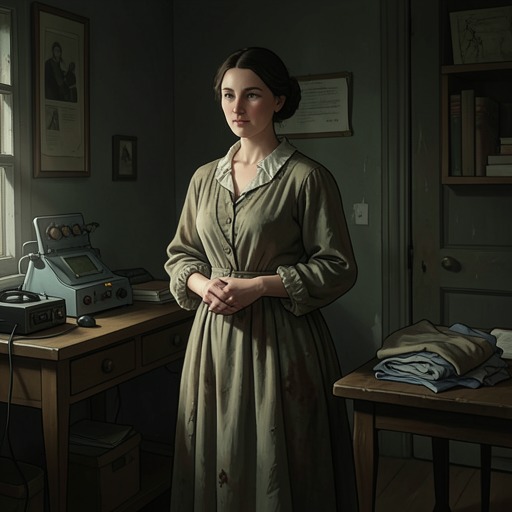
Betsey Trotwood’s husband reappears
David CopperfieldBetsey Trotwood’s husband reappears in a midnight encounter that exposes the concealed history behind her guarded generosity: although he betrayed and impoverished her, she continues to give him money so that he can leave without being punished. The scene turns a familiar figure from Betsey’s past into a living presence, and makes her private compassion inseparable from the damage he caused.
The Midnight Encounter
David Copperfield returns home at midnight after accompanying Daniel Peggotty. He notices that the door of his aunt’s cottage is open and a faint light reaches across the road. In the garden stands a man David recognizes from earlier encounters: on one occasion he had thought the man might be a delusion of Mr. Dick’s, and on another he had seen him with Betsey in the streets of the city. The visitor is eating and drinking, and appears curious about the cottage while also seeming eager to go.
Betsey comes out and places money in the man’s hand. He challenges the amount and says he cannot leave; she answers that she can spare no more. When he offers to return the money, the exchange makes plain that this is not a straightforward transaction between strangers. Betsey calls him a bad man and asks why he takes advantage of her weakness. Her question reveals both her anger and her recognition that he knows how difficult it is for her to refuse him.
The Identity Revealed
After the man has left the garden, Betsey asks David to sit with her and not speak for ten minutes. Once she has composed herself, she tells him the visitor is her husband. David had believed the man dead; Betsey distinguishes between being dead to her and being alive. The revelation reinterprets the earlier sightings: what had seemed an unexplained figure, or possibly a mistaken perception, was a person connected to Betsey by a history she had kept secret.
Betsey recounts that she once trusted and loved her husband deeply. She had been willing to give him every proof of affection, but he broke her fortune and nearly broke her heart. She says she left him generously, although his cruelty would have allowed her to arrange a separation on easier terms for herself. According to her account, he soon squandered what she gave him, declined further, and became an adventurer, gambler, and cheat. She also believes he married another woman. Her memory of him is not wholly detached: she recalls that he had been handsome when they married and that she had taken him for a man of honor. She judges her earlier trust as foolish, but does not deny that it was sincere.
Why Betsey Keeps Paying Him
The money in the garden is part of a repeated arrangement. Betsey explains that her husband returns at intervals, and that she gives him money to go away rather than have him punished for his offenses. Her choice is costly: she tells David that she has suffered losses and is poorer than before, and that the sum she can give is all she can spare. The encounter therefore shows her generosity operating under pressure, not as easy benevolence. She knows the man has injured her, yet remains unwilling to expose him to the consequences she believes he would face if he continued prowling in the country.
Her response does not amount to reconciliation. She calls his treatment false, ungrateful, and cruel, tells him to repent, and insists that he should not add fresh injuries to the old ones. He acknowledges his shabby condition, but the encounter supplies no evidence of reform or restored trust. When David meets him at the gate, the two men look at one another without favor. Betsey, by contrast, says that her husband is now nothing to her, even as her actions show that the past still governs what she will do for him.
Disclosure and Narrative Significance
The scene moves from observation to explanation. David first sees a visitor receiving money; only after the visitor departs does Betsey supply the history that makes her conduct intelligible. Her pause before speaking, and her request that David keep the account to himself, mark the story as a private disclosure rather than a public justification. She presents it as the beginning, middle, and end of the matter, then asks that they never discuss it again.
That disclosure complicates the image of Betsey as merely firm and self-reliant. Her firmness coexists with a lasting attachment to what she once believed her husband to be, and with a reluctance to let him suffer even after he has diminished her means and betrayed her trust. The encounter also alters David’s understanding of his aunt: the man he had seen before was neither a delusion nor an incidental stranger, but the surviving consequence of a painful marriage. The visitor leaves; the secret does not. Betsey’s account gives the brief exchange its weight, showing how an old injury can continue to direct a person’s choices long after the relationship itself has ended.